
Montgomery County Arrest Records and Charges
Montgomery County arrest records can include the arrest event, agency information, booking path, intake, custody status, release conditions, or correctional records depending on the agency and access rule. The court charge record begins when a charging document enters District Court or Circuit Court. That charge record may show the charge description, statute reference, court, case number, filing date, status, and later disposition. Montgomery County does not have a confirmed official live public jail roster, so public access should not be framed as a mugshot search.
For custody and booking information, the county route is the Department of Correction and Rehabilitation, VINE or VINELink where applicable, state custody tools after transfer, and public-information channels for releasable DOCR records. For charges filed after arrest, use Maryland Judiciary Case Search and the court where the case was filed. For the complete court case, including plea, disposition, and sentencing, use Montgomery County criminal court records.
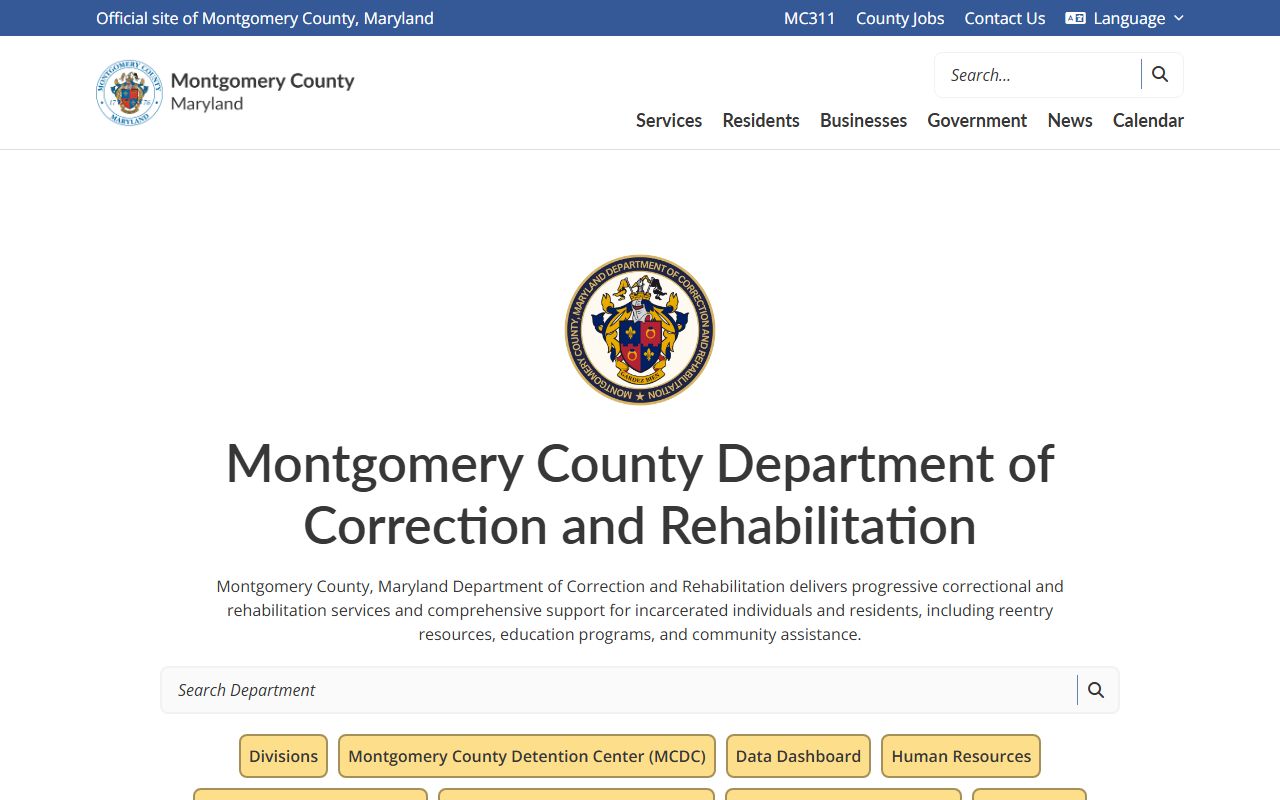
The Montgomery County Department of Correction and Rehabilitation site provides correctional service and inmate/resident information links, but the research did not confirm a public live inmate roster.
Find Montgomery County Arrest Records
Use a two-track search. First, check the court side through Maryland Judiciary Case Search for filed charges, docket entries, and charge status. Second, use DOCR or custody channels for booking and detention information when the person may be in county custody. Case Search can show a filed charge or warrant-related event, but it is not a booking database. DOCR may hold booking or correctional records, but many internal fields are not public.
- Search Case Search by defendant name or case number and narrow to Montgomery County when possible.
- Confirm the court location, because District Court - Rockville, District Court - Silver Spring, and Circuit Court files use different counters.
- Open the case summary and read each charge line, filed date, and docket entry.
- Check whether the charge was amended, reduced, dismissed, placed on stet, resolved by plea, or sent to sentencing.
- For custody records, use DOCR information channels, VINE where relevant, or a DOCR MPIA request for releasable records.
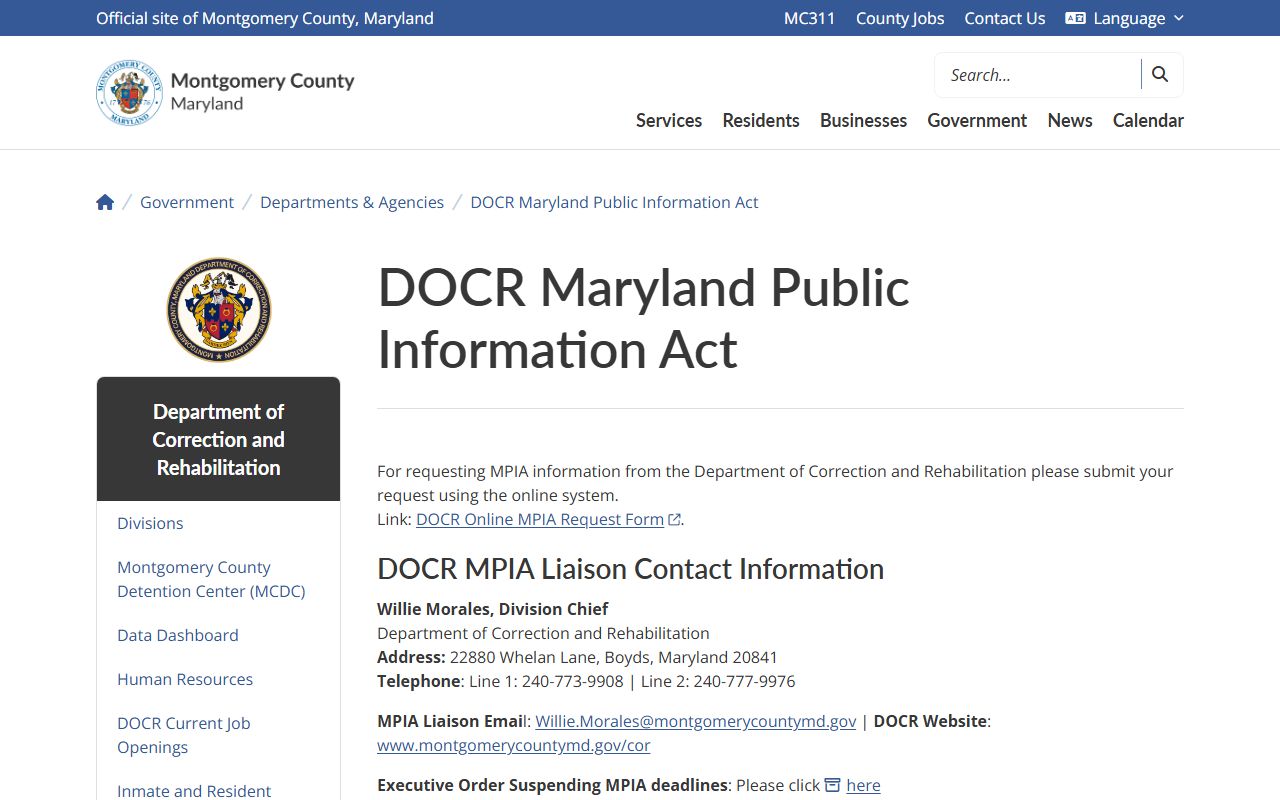
The DOCR MPIA request page is the official route for public-information requests to the correctional agency when a releasable agency record is not posted online.
Montgomery County Charges After Arrest
Charges after arrest are filed through charging documents. The charge may begin with a statement of charges or complaint, then move through prosecutor review, amendment, information, indictment, dismissal, plea, trial, or sentencing. The Montgomery County State's Attorney's Office is the prosecuting office for state criminal cases and may decide whether to pursue charges, amend them, enter nolle prosequi, negotiate plea terms, or recommend sentencing. Police or commissioner paperwork can start a case, but prosecutor and court actions shape the public charge record.
| Complaint / Statement of Charges | Information | Indictment | |
|---|---|---|---|
| Filed By | Officer, complainant process, commissioner path, or prosecutor depending on case type. | Prosecutor. | Grand jury process. |
| Common Use | District Court criminal matters, misdemeanors, and initial charging paths. | Formal prosecutor-filed charges, often for Circuit Court matters. | Serious felony or grand-jury-reviewed charges. |
| Record Effect | Creates or supports the court charge entry. | Defines the charges the State elects to pursue. | Moves serious allegations into a formal court track. |
| Where Checked | Case Search and the District Court or Circuit Court file. | Circuit Court file and docket entries. | Circuit Court file and docket entries. |
Montgomery County Charge Status
A charge can change as soon as the prosecutor reviews it or as late as plea, trial, sentencing, or post-judgment activity. One arrest can produce several separate counts. Read each count on its own. A case can show one charge dismissed, another reduced, and another resolved by probation before judgment. A public search should also compare the current charge status with later docket entries.
| Status | What It Means |
|---|---|
| Pending | The charge is filed and has not reached a final public disposition. |
| Amended / Reduced | The charge was changed, often by prosecutor action or plea negotiation. |
| Dismissed | The court ended that charge without a conviction on that count. |
| Nolle Prosequi | The prosecutor chose not to pursue that charge. |
| Stet | The case is placed inactive under conditions and may be reopened. |
| Probation Before Judgment | Maryland disposition where judgment is stayed while conditions are imposed. |
Montgomery County Charges Compared
Charge records are accusations, not proof of guilt. A conviction follows a plea or finding of guilt. Montgomery County court charge records can remain visible even when the final result is dismissal, acquittal, nolle prosequi, stet, or probation before judgment, unless later shielding or expungement changes public access. Always read the charge status and disposition together.
| Charge | Conviction | |
|---|---|---|
| Meaning | An allegation filed in court after arrest or charging review. | A guilty plea or finding of guilt on a count. |
| Timing | Early in the case and may be changed later. | Near disposition and sentencing. |
| Proof Level | Based on charging standards and probable cause. | Based on plea or proof beyond a reasonable doubt. |
| Record Check | Read the charge line and docket updates. | Read the final disposition and sentencing entries. |
Sealed Montgomery County Charge Records
Maryland law can limit public access to eligible charge records. Expungement under the Criminal Procedure Article can remove eligible records from public search. Shielding can limit public visibility while preserving some official access. Juvenile charges, sealed warrants, minor-related materials, and investigative law-enforcement records are also restricted. A missing public result is not proof that no arrest, charge, or case ever existed.
| Sealed or Shielded | Expunged | |
|---|---|---|
| Public Access | Hidden or limited by statute, rule, or court order. | Removed from public access after an eligible order. |
| Record Type | May apply to case files, juvenile matters, protected data, or eligible shielded records. | Applies to eligible criminal charges and dispositions. |
| How Requested | Usually through the court with control over the file. | Petition in the court that handled the criminal charge. |
| Search Result | May show limited status or no public detail. | Should not appear as an ordinary public case result if granted. |
Montgomery County Charge Codes
Montgomery County charge entries may use statute references, plain-language descriptions, traffic or criminal labels, misdemeanor or felony levels, and separate count numbers. District Court commonly sees misdemeanors, traffic-related criminal matters, and preliminary hearings. Circuit Court handles felony criminal cases, jury trials, and major criminal filings. DUI/DWI charges can begin in District Court but may involve mandatory court, criminal traffic processing, probation, treatment, and license consequences.
Charge wording can change. An original charge may be amended by information, reduced by plea, dismissed by the State, superseded by indictment, or resolved on only one count. For any official purpose, get the certified disposition from the court rather than relying on a screenshot or third-party summary.
A person may know the arrest date, arresting agency, or booking location before the court charge is easy to find. The court charge record is organized around the filed charge and court case number, not always the police incident number or jail booking number. If Case Search does not show a charge yet, the matter may still be in intake, commissioner review, prosecutor screening, sealed status, or a non-court law-enforcement channel.
Montgomery Prosecutor Charge Channels
The Montgomery County State's Attorney's Office handles state criminal prosecutions. Its page lists 50 Maryland Avenue, 5th Floor, North Tower, Rockville, MD 20850, phone 240-777-7300, and Monday through Friday, 8 a.m. to 5 p.m. hours. John McCarthy is identified as State's Attorney. The office also maintains a prosecution data dashboard, but that dashboard is not the official case file.
Federal charges are separate. A federal arrest or prosecution tied to Montgomery County routes through the U.S. District Court for the District of Maryland, the U.S. Attorney for the District of Maryland, PACER, CM/ECF, and sometimes federal custody systems. The U.S. Attorney for the District of Maryland is not a county court record office.
Restricted Montgomery County Charge Records
Restricted charge records include juvenile matters, sealed cases, sealed warrants, expunged cases, shielded records, mental-health filings, protected identifiers, and investigative material. Law-enforcement records may also be denied or redacted if they involve active investigations, safety risks, confidential sources, juveniles, or court-sealed information. For a person who was arrested and then released, the public court charge may still be the best visible record if the prosecution filed a case.
Montgomery County users should also separate police incident reports from court charge records. A police report may describe the alleged event and agency response, while the court file shows whether a charging document was filed and how each count moved through court. If the prosecutor declines or later drops a charge, the arrest event and the court charge result may not tell the same story.
Charges that end in dismissal, acquittal, nolle prosequi, stet, probation before judgment, guilty finding, or transfer do not carry the same access and eligibility results. A public charge entry also does not prove a conviction by itself. Read the disposition field, sentencing entries, and any post-judgment docket activity before drawing a conclusion from the charge name alone.
Important: Arrest and charge records are not FCRA screening reports and must be verified with the originating official office.